Thursday, July 21, 2016

A visit to Paso Pacifico

One of our goals for this summer is to visit projects in the area that have done or are doing what we hope to do with guides on Ometepe. We had heard through networks of ecotourism development organizations of Paso Pacifico (www.pasopacifico.org), a group dedicated to protecting the ecosystems of the isthmus between the Pacific Ocean and Lake Nicaragua, a major wildlife corridor in the dry forests of western Central America. Thanks to the funds we raised through our crowdfunding site, we are able to take Arlin, the president of the cooperative of guides from Altagracia with us.

Paso Pacifico has a wide variety of projects going at once, including scientific monitoring and studies of wildlife in the area from jaguars to sea turtles to native bees, coordination and formation of groups of local fisherman, farmers, and business owners to support eco-friendly economic development, community education, formation of forest and marine reserves, reforestation, and ecotourism development. That's a lot of projects, but they've been doing this for over ten years, and have offices in California, Managua, and the small town of Ostional on the coast with dozens of full-time employees. Their list of accomplishments is impressive, but even more impressive is their list of new projects and new ideas.

We visited the projects near Ostional and Reserva Natural Playa La Flor, which is an awfully nice place for an office:

Our guides, Liza Gonzáles and Maritza Rivera, told us of strides in turtle protection on this beach, which can see thousands of turtles laying eggs per night at the peak of the nesting season.

We stopped by the visitor center

and met some of the park rangers of MARENA, Nicaragua's Ministry of the Environment and Natural Resources, which has official oversight over the protection of turtles and beaches, but is understaffed. These guys work hard.

Strangely, this beach, with its visitor center right there and restaurants ten minutes away, was the setting for the "reality" show Survivor Nicaragua.

Let's just say all the participants survived.

We also popped into a classroom of junior rangers, an extracurricular program in its fourth year in the region.

These kids attend classes three afternoons a week for about a year, missing a maximum of three classes in the year, to learn about the flora and fauna surrounding them and what they can do to protect it. When they graduate, they receive a uniform shirt, backpack, binoculars, and other useful items for prospective ecotourism professionals. With a greater than 90% graduation rate, and a total of several hundred graduates in the last three years, we can definitely call this project a success.

Liza and Maritza needed to attend a meeting of women in a brand new project, harvesting oysters to sell to tourist restaurants in the region.


This seems to be a successful project so far, and even if the future doesn't hold much financial success, I'm a little jealous of their daily commute:


I can't call our job too hard, though. During this working visit, we got treated to a boat tour.
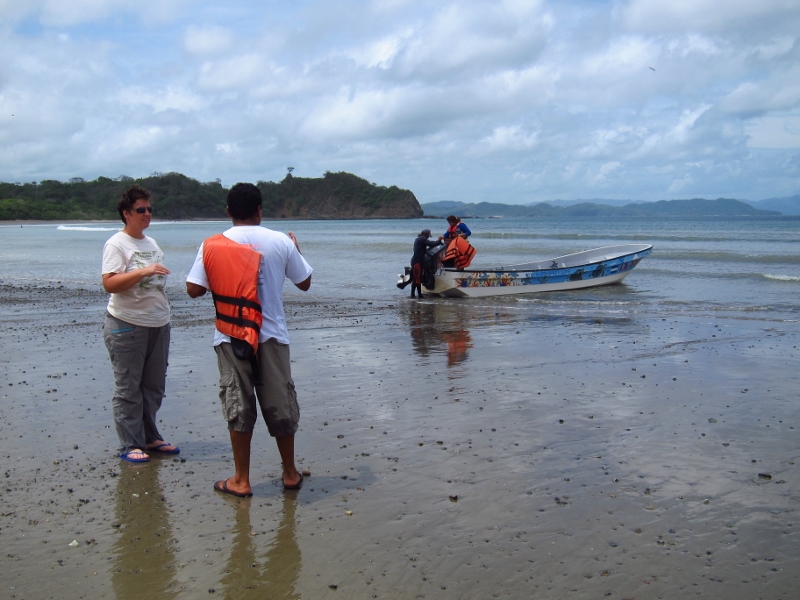
One of the completed projects Paso Pacifico started when it was still a new organization was tour guide training and park ranger training. They developed these boat tours as a unique option the guides of Ostional could offer tourists that included seeing hard-to-reach beaches where turtles come to lay eggs, snorkel in amazingly clear water, and learn from well-trained guides.

We kept seeing people in heavy-duty snorkel and scuba gear out in the water.

Turns out this is also an area much preferred by local fishermen, who snorkel for octopus.

The boat tour was fascinating, with lots of interesting animals and plants to see. The geology wonk in me couldn't help but get excited about the rocks.

But we saw a couple of turtles, and they stole the show, of course.

They're awfully hard to photograph from outside the water...

This visit gave us a lot to think about, and a great feeling that projects like ours are possible and can have great results. We're grateful to Liza, Maritza, and the Paso Pacifico crew for the tour and hospitality, and for answering lots and lots and lots of questions.

We arrived back on Ometepe excited about the possibilities, and happy to be home. And it really does feel like home!

Thursday, June 30, 2016

Workshoppin!

We are hard at work here in Altagracia!
We had our first workshop on Tuesday, 28 June, with 18 guides attending. When we asked a couple weeks ago about what topics they wanted, we heard loud and clear that they wanted to know about "La Cultura Turistica," or tourist culture - basically, what do tourists want?

We discussed a lot about professionalism, and cultural differences between Europe, the US, and Nicaragua. Stereotypes and exceptions to stereotypes, machismo and sexism, being there to assist vs. harassing passersby - there was a lot to discuss. These guides are somewhat self-selected, of course, so those who attend trainings are often already aware of cultural differences. But some things die hard. For example, at the end of the workshop, they wanted to ask one of the female guides to serve the juice and donuts provided. That made for a teachable moment about  how in the US, it would be unethical to specify that they want a woman to do the serving in a work setting. So they put the question out there, and of course the women volunteered. But at least there was a discussion!

Another repeat visitor to the island who had toured with Arlin, the president and founder of the group, had come back with five pairs of quick-dry hiking pants as a donation. They drew names from a bag to choose who got them, and the winners were pretty happy:
We are also working with the kids at the before- and after-school care center of the project Si a la Vida, who talks to teachers to select students who are at risk of falling behind, or have a particularly tough home life, or learning deficiencies of some sort. Our contribution is to teach some environmental education classes like we do in the US. We're pretty surprised at how well they work here.
 The kids have so far drawn habitats for birds, played a memory game of local bird species, and talked about the food web of the lake. Jeff's food web demonstration, for example, had them jumping up and down to give examples of animals that might eat an insect, and then animals that would eat that animal, etc.
It is always nice to get that kid time. Not only does it rejuvenate the environmental educator in both of us, but it's great Spanish practice. Kids are so willing to correct mistakes without any self-consciousness or worry that they'll offend. And they get excited about *everything*.

Soon, our friend and coworker in the Everglades, Jen Lopez, is coming to visit for about a week and a half. We'll be putting her to work, for sure.

Dale pues!

Wednesday, June 22, 2016

Settling in

Greetings from Altagracia, Ometepe, Nicaragua! We're getting settled in here, and have been through a flurry of meetings with local groups who work with tourism and ecological development in the area. Many of these meetings will look familiar to anyone with an office job anywhere:

Even down to the powerpoint presentations!

We're impressed by the amount of work already being done, and the awareness of people here as to the challenges they face and the willingness to put the work in to fix the problems. For example, the above photos are from a meeting with a new group of hotel owners, tourism experts, and environmental professionals who are organizing to improve access to Volcan Maderas Natural Reserve. We are honored to be included in the group.

Less common in most professions is the rocking chair meeting, but this is the type that we will be doing most of the time:

The group of guides that we are working with have meetings like this all the time. We attended one last week to discuss topics for our workshops and trainings, and to distribute and discuss the equipment we brought down. There was much posing for pictures:


We got down to business, though, and made the following list of topics to cover:
- Tourist culture - what do the tourists want? What do they consider professional?
- Activities to use during tours
- What in the US park service we call interpretation - how to make a tour make an impression
- Resource knowledge: geology, plants, insects, birds, etc.
- First aid practice - hopefully, there will be a Red Cross training as well

We've spent a lot of time working with this guy:

Arlin is the one we met in the park in Altagracia all those years ago who was organizing a group of tour guides and wanted training, who we have been in contact with ever since via email, who has done an incredible amount of work to improve the work of and resources for the guides of Ometepe. We look forward to much more work together.

But, of course, it's not all work. A cousin works for United Airlines and was able to help us carry all the gear down here, so we took a couple days to enjoy the island with her. A huge thanks to prima Becky!

And we've had the challenge and the fun of finding a place to live. There is no realtor.com or classifieds section down here like there is in the US, so we had to network to find places for rent. We asked anyone and everyone - the guides we work with, local gringos like Peace Corps volunteers, and ultimately anyone we met at shops and restaurants around town. Surprisingly, the market is quick in this little town, so a couple of places got snatched up before we could see them. But ultimately we found a very interesting option and went with it.

Si a la Vida is a group founded twenty years ago in Managua, the capitol and Nicaragua's largest city by far, to get kids off the street. For many years, they took kids who had difficult enough family lives (or no family at all) to be sleeping on the streets or begging in the markets and put them up in a home with regular meals, a good education, and caring supervision. Some they brought to Ometepe to give them a calm, quiet place to heal. Here, they had a plantain farm with two buildings full of rooms for the kids to stay in. A year ago, the government of Nicaragua decided that all children are better off with their families, and required the Si a la Vida kids to be returned to Managua. Since then, the housing has sat empty. Ideas to turn it into a hostel for volunteers are floating around, but they require a lot of time and work - and that's where we come in.

We've moved in and are getting all of the supplies to make ourselves comfortable. The kitchen is now fully stocked, and our room is secure and going to be bug-proofed at some point (time - always we need more time). There's also lots of meeting space for our guide trainings, so lots of them will happen here, I think. The view may be a bit distracting, though...

We needed comfortable places to siesta during the hottest part of the day. That means hammocks, of course, which required a trip to Masaya.


Masaya is close enough to Managua that the craziness of city life and of travel were tough on these two travelers. Happily, though, we're back on the island, and making headway on our project (if not on the bugs). We were reminded that we were almost home on the ferry, where the island's "tranquilo" way of living allows for some bending of the rules:

Quite the fashion statement that guy has with his now-required life vest. Whatever - it floats, right?

A big shout-out to all of those of you who have helped us along the way. Your support is helping make this a reality, and we are grateful!

Tuesday, June 7, 2016

Off we go!

We're on our way! After a flurry of packing that followed a month of seeing family and getting lots of work done in Washington, we're finally heading out to begin the on-site work in Ometepe. 
Goodbye for now, Washington!
The support we've gotten is amazing. Many people are cheering us on at home, and even people we connected with professionally but never actually met have expressed their support. Our crowdfunding site plus extra donations totaled well over $2000, and we've got the goodies to show for it:
Surprisingly, this all packed into two suitcases - very big, very full suitcases, but just two. And a cousin of mine who works for the airline we're flying is bringing them down for us, donating her vacation time to carry all that gear.

We're pretty excited to bring down good hiking equipment, of course, including some shoes we found barely used and trekking poles to see if the guides feel they help. But backpacks - oh, the backpacks:
We got several different styles to see what the Nicaraguan guides prefer. Frame or no frame? Big or small? Lots of pockets or few? We'll let them choose.

Books and binoculars, though, are really in the most limited supply down there. You may not be able to get really good shoes and backpacks, but you can get something that functions there. Books and optics are much harder to come by. So we're bringing lots of books (see the last post) and several pairs of binoculars. 
In addition to the funding from friends and family, we got a small grant from an organization called Idea Wild, which purchased these items:
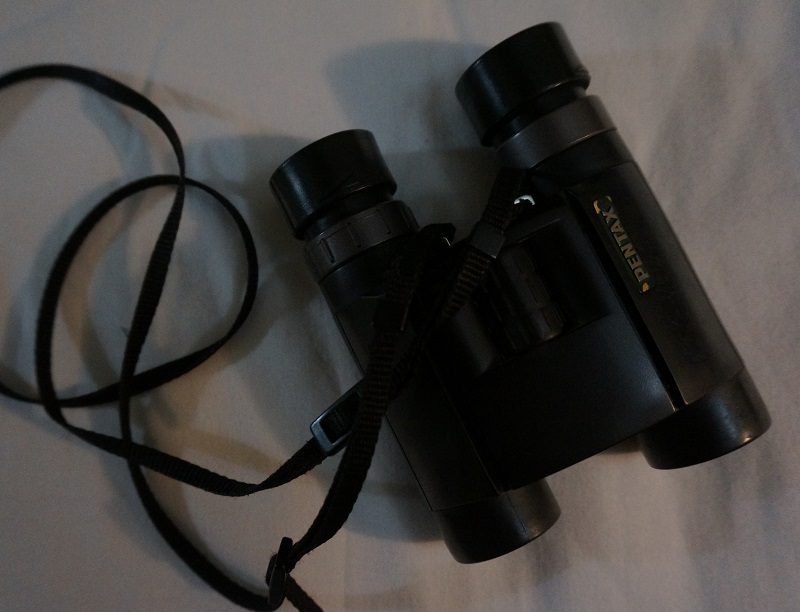
The binoculars Idea Wild donated turn out to be pretty fancy, actually, so I hope the Ometepe guides don't get too attached to them - we will have to get really creative to afford (or even find!) lots of those. But it sure is nice to see that our project can get support in the international arena.

Now it's time to see if it gets local support, though, so wish us luck. Especially in schlepping all of this stuff to the island!

Sunday, March 6, 2016

Over and above!

It's official - we are now OVER our goal for donations for equipment for the guides of Ometepe!


Thank you to all our donors, to all of you who shared our pages, and to all our friends and followers! You're helping us amplify our impact, and for that we are truly grateful.

Donations beyond the $1500 mark will be happily accepted, and put toward travel expenses for visiting other projects around the region. We would like to visit successful schools for tourism in Nicaragua and Costa Rica, connect with Nicaraguan and US officials in Managua, and true to our ranger selves, we will definitely see how National Parks are run in Nicaragua and Costa Rica as well. The youcaring.org site is still up and running at https://www.youcaring.com/guias-unidos-511831

And to all of you reading this, thank you for your interest. We can't tell you how much it means to us!

Gratefully,
Jeff and Kate

Monday, February 22, 2016

First financial investments

Donations are coming in, and we’re so excited and grateful for all the support! We are applying to grants to add to the family-and-friends campaign, and we have a pretty good list going of what we plan on buying with all of that.

We have already bought some books, and plan on buying many more. Some of those are ones we had for ourselves and will donate to the cause, including environmental education classics:

English language, but simple enough.
…and just plain good reads (since it’s hard to get good books on the island):

To get people to read, you need something interesting first.
Left to right: The Glass Castle, by Jeannette Walls, Ender's Game, by
Orson Scott Card, and Burro Genious (a Mexican-American memoir)
by Victor Villasenor.
We plan on helping with English learning, so we have some easier books in Spanish and English – this collection will be increased for sure:
The Lorax, by Dr. Seuss (which we will get an English copy of soon),
Hoot by Carl Hiaasen, and a side-by-side English-Spanish compilation of
many Curious George stories, by H.A. Rey.
Of course, we have some more serious guiding necessities:

Nicaragua-centric field guides really aren't a thing, apparently.
We will be getting more field guides, and more copies of each one, so copies can be shared around. More than anything, though, we will be looking at which work best, and perhaps compiling a guide or guides of local flora and fauna in Spanish with local names. That, though, requires a lot of time on the island to narrow down the huge number of species in each book to what’s actually seen around Ometepe.

Of course, for real birding, etc, one needs a decent pair of binoculars. Considering the conditions there, including heavy seasonal rains, humidity, and cloud forests at higher altitudes, binoculars need to be sturdy to handle field use. And, of course, they can’t be too pricey, so we can afford enough pairs for many tour guides to use. Jeff is a master internet researcher and found these:

He’s been using these for a few years now, and gives them a high rating. However, to be sure they’re the best for the conditions, we’d like to get a couple pairs of other, similar types to test out.

We’re looking into getting daypacks, basic first aid equipment and books, and perhaps things like trekking poles and decent hiking shoes, for the tour guides down there as well.
Getting all of this down there will be a trick, but we have people down there to send some to in the mail (international shipping is pricey, though!), some friends in the airline business, and hopefully friends visiting who can ferry stuff down. We definitely won’t be doing one huge load, as we will want to try some things out before buying in bulk for all the tour guides. Good thing we’ve dealt with these kinds of logistics before in our seasonal living and international travel!

This is all very exciting, but we still have our jobs to do in Florida for a few months. Also, some exploring. This is us over the weekend, remembering to live life in the present!


Cheers, and thanks for your support!


Sunday, February 7, 2016

Why Ometepe?

We have traveled in several countries and on several continents. We have volunteered in many places, mostly as a way to get to know a place more than we would as tourists. We've seen many places we love and many places we feel we could help. So why Ometepe Island, Nicaragua?

You mean, besides this?

Playa Santa Cruz, Ometepe, Nicaragua
Ometepe is one of the most beautiful, unique places we've been. It's not an island on the coast of the country, it's an enormous island in an enormous lake, Lake Nicaragua (locally called Lago Cocibolca). The outward beauty is obvious, but we love the culture, too. The residents of Ometepe, as well as most of the people we met in Nicaragua, are very friendly and open, and are rightly proud of their natural resources, their culture, and their communities. They are more than happy to invite people in and show them their lifestyle, and it is a wonderful, family-oriented, community-loving lifestyle. 


Learning basket weaving in Balgue, Ometepe, Nicaragua
The ecology of the area is recognized as important by the Nicaraguan government and international bodies such as the United Nations. The island was established as a Natural Reserve and National Cultural Heritage Site by the Nicaraguan government in 1995, and as a UNESCO Biosphere Reserve in 2010. Our experience working with the National Park Service in the USA leaves us wanting more of a protection presence, however, which may rely on locals, most especially tour guides.

Tourism is increasing as international travelers discover that Nicaragua is no longer the war zone we heard about as recently as the 1980s. As more foreigners visit, Nicaraguans very much want to share their country, but sometimes don't have the resources to do so the way they would like. In many places where a boom in tourism has happened, this results in large companies buying huge plots of prime land to make resorts. The community feeling is lost, and while community members can get jobs, they have no ownership over the tourism in their area.


Barcelo Hotel and Resort, Montelimar Beach, Managua, Nicaragua
Other projects coming into the area could potentially threaten the environment and communities of Ometepe, most especially the planned Nicaragua Canal, a larger alternative to the Panama Canal. It is to run through Lake Nicaragua, right past Ometepe Island. If done right, the Ometepe's could benefit financially from the project; if done wrong, they could be devastated. Local communities must be able to insist on being compensated, but in a country as poor as Nicaragua, money often wins out.


Proposed route of the Nicaragua Canal, to be started in late 2016
Latin American Association of Ports and Terminals
Both of these challenges are huge and difficult to overcome, but Nicaraguans are aware of the problem and willing. Perhaps with some help, their voices can be heard, and need for development can be balanced with need for preservation. Several organizations are working toward preservation (Flora and Fauna International, Seacology, Paso Pacifico, etc.),  but a unified front may be the best way to make an impact.

Another challenge, likely easier to overcome, is the lack of education for local tourism guides. Although primary, secondary, and higher education are free, most families cannot afford any form of higher education due to the time and travel expenses. With only a handful of bookstores in the entire country, and with almost a complete lack of country-relevant nonfiction books on conservation and natural history topics, even self-education can be hard to achieve in Nicaragua. Many people who normally would make a living by farming or running a small store discovered early that they could easily get $5 to $10 to lead a tourist up a mountain, which was a lot of money - but that tourist is often hoping for an educational experience, and is usually relying on their guide to have some first aid experience. Here is where our experience and training from working with the US National Park Service, as well as many other educational organizations, can come in handy.


Kate working with Nicaraguan community members as a Green Empowerment volunteer, 2011
In 2012, we visited Ometepe and met a tour guide who was starting a cooperative of local guides. The guides of "Cooperativa Guias Turistico de Ometepe" have managed to organize and educate themselves to form a very competent conservation organization, despite the economic challenges they face. They would like to create a curriculum for training so there could be a standard they could live up to and advertise. In late 2012, we organized two workshops with the cooperative, with great interest and participation from all involved. Although training and resources are hard to come by, enthusiasm among the guides is strong. 


Guias Unidos and Cooperativa Guias Turistico de Ometepe, 2012
Our plan is to work with the guides of Ometepe, as well as other local tourism professionals, to create a training curriculum of topics needed for good guiding on the island. This will include earth sciences, anthropology, first aid, tour techniques, and language skills. We will also work to supply them with materials needed to learn and lead; not much is available in-country as far as books, gear, etc., and purchasing internationally is difficult because there is no in-country mail service.

We would like to help support and link other organizations doing work on the island and in the country as well, with the hope of strengthening the voices of Nicaraguan communities and conservationists. After talking with several people from several organizations, the obvious thing lacking in unifying their efforts is time and resources, both of which we hope to provide.


There is a lot of work to be done, and we're looking forward getting started this summer!